There's a quiet revolution happening on dining tables across the world, and it smells like melted cheese.
In an era when most cooking has retreated behind kitchen doors — plated, polished, and presented as a finished product — a growing number of home cooks are pulling the heat source out from the kitchen entirely and setting it right at the center of the table. Raclette grills. Fondue sets. Crepe makers. These are not retro novelties dusted off from a grandmother's cabinet. They are instruments of something increasingly rare: a meal that is also an event.
This guide covers everything you need to know about all three — what they are, how they work, which models deserve shelf space, and why they matter more than any sous vide circulator or air fryer you've ever bought.
Raclette Grills — The Swiss Export That Changed Dinner Parties Forever
What Is Raclette, Actually?
Raclette is both a cheese and a cooking method, and understanding the distinction matters when you're shopping for equipment.
The cheese — a semi-hard, washed-rind Alpine variety from the Swiss canton of Valais — has been eaten since the Middle Ages by Swiss herders who melted it beside campfires. The name comes from the French verb racler, meaning to scrape. That's the move: melt the cheese, scrape it over food. Potatoes, cornichons, charcuterie, pickled onions. The ritual is simple to the point of being meditative.
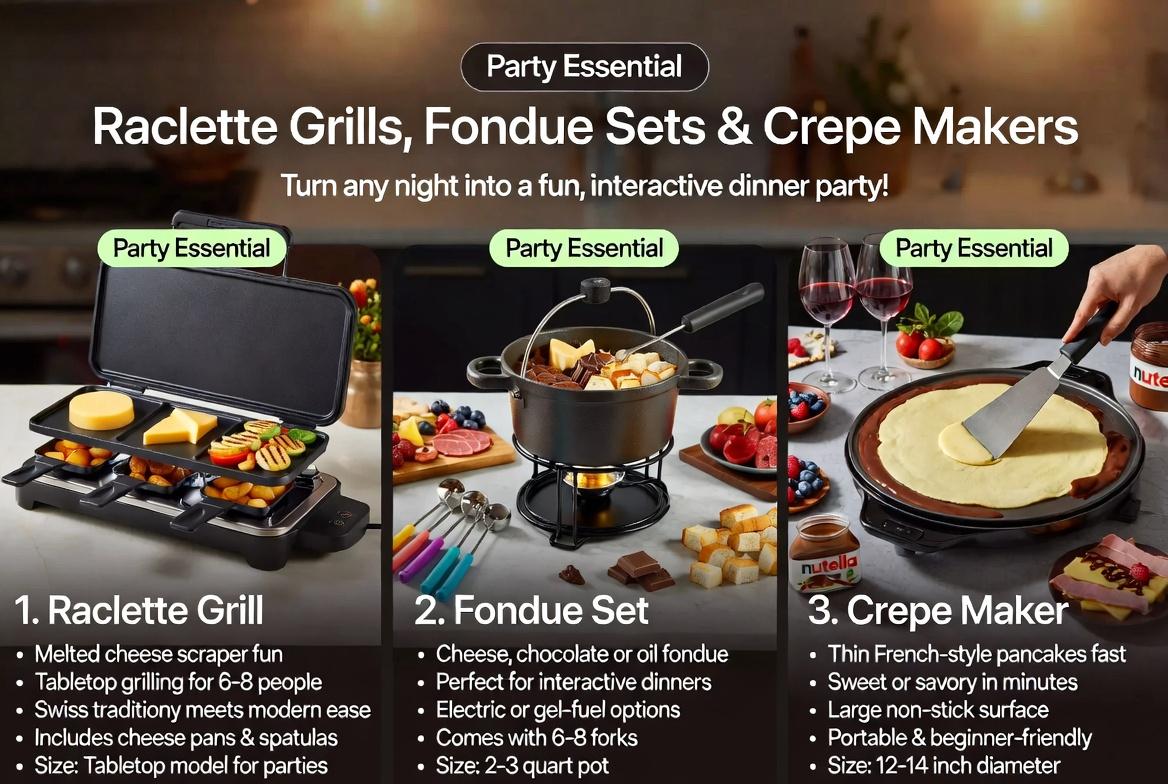
The modern raclette grill brings this into your home in a format that feeds a crowd. The centerpiece is an electric grill plate on top — typically a cast iron or stone surface for grilling vegetables, meat, shrimp, whatever you like — and beneath it, a row of small individual trays called coupelles or raclonettes, each designed to hold a slice of raclette cheese. Each diner loads their personal tray, slides it under the heating element, and waits for the bubbling moment to scrape over their plate.
It is participatory. It is slow. It is, in the very best sense of the word, communal.
How to Choose a Raclette Grill
The market divides into three broad categories: traditional paddle-style raclette heaters (designed for a half-wheel of cheese, not practical for most homes), tabletop electric raclette grills with individual trays, and hybrid models that combine raclette with a hot stone or teppanyaki plate.
Size and Capacity
Raclette grills are almost universally sold by the number of trays — typically 4, 6, or 8. An 8-tray model is the gold standard for a dinner party. A 4-tray version is well-suited for couples or smaller families and takes up significantly less counter space.
Grill Surface Material
This is where quality divides sharply. The grill plate on top — where you cook the savory accompaniments — can be:
- Non-stick coated aluminum: Heats quickly, easy to clean, but degrades over time, especially if you use metal utensils.
- Cast iron: Retains heat beautifully and creates a better sear. Heavier, slower to heat, requires a bit of care.
- Natural stone (granite or lava rock): The most dramatic and arguably most functional surface. Stone radiates heat evenly, doesn't require oil, and looks spectacular on a table. It also takes 15–20 minutes to fully preheat.
Wattage
Look for a minimum of 1,200 watts for a full 8-person grill. Under-powered models take too long to heat the cheese trays and often can't maintain consistent heat across the full grill surface simultaneously.
Tray Design
The best coupelles have a slight lip to prevent cheese overflow and are made from materials that heat evenly — not just on the direct-contact edge. Wooden spatulas are typically included; check that they're sturdy enough to actually scrape without bending.
The Best Raclette Grills Worth Buying
Swissmar Stelvio 8-Person Raclette Party Grill — The benchmark product in this category. The reversible cast aluminum top switches between a ridged grill and flat griddle surface. Eight Bakelite-handled trays, a sturdy stand, and a 1,200-watt heating element. It heats evenly, cleans easily, and looks the part. This is the grill that has been showing up at dinner parties for two decades for a reason.
Boska Holland Raclette Set — A Dutch-made option that leans into clean Scandinavian aesthetics. The natural stone top surface is a genuine standout feature, and the trays are larger than average — useful if you're loading up on cheese and toppings. Slightly slower to preheat but the cooking surface quality is notably higher.
Lagrange 2-Person Raclette — For the couple who wants the experience without the crowd. Compact, well-built, with two trays and a small grill surface that's disproportionately capable. Excellent for a weeknight raclette that doesn't require moving furniture.
What to Serve at a Raclette Dinner
This is where most guides stop giving useful advice. The cheese is obvious. The potatoes are obvious. Here's the less-obvious part: raclette is infinitely flexible.
Beyond the classic accompaniments of waxy boiled potatoes, cornichons, and charcuterie, the grill surface invites experimentation. Sliced mushrooms grilled directly on the stone. Cherry tomatoes that blister and collapse. Thinly sliced fennel that caramelizes at the edge. Prawns. Asparagus tips. Day-old bread that crisps against the surface and catches the cheese overflow.
The cheese itself doesn't have to be traditional raclette. Gruyère, Appenzeller, Comté, even young Gouda — all melt beautifully and bring their own character. A table with three or four different cheeses becomes its own tasting event.
Fondue Sets — The Art of Dipping, Done Properly
A Brief History of the Pot That Became a Cultural Moment
Fondue has had at least three distinct cultural lives. First, its Alpine origins as a practical way for Swiss and French mountain communities to use aged cheese and stale bread through winter months. Second, its unlikely transformation into the defining dinner party centerpiece of 1970s America, fueled partly by a 1964 promotion by the Swiss Cheese Union that swept through North American food culture. Third — and this is where we are now — its return as a genuinely pleasurable, unhurried way to share food that owes nothing to nostalgia.
Modern fondue culture has also moved well beyond the cheese pot. Fondue Bourguignonne (hot oil for cooking meat), chocolate fondue for dessert, and broth-based Asian-influenced fondues have expanded the category into something that can anchor an entire dinner, not just one course.
The Three Types of Fondue Sets
Cheese Fondue Sets
These use a ceramic or enameled cast iron pot — known as a caquelon — positioned over a small flame or electric element. The material matters: ceramic distributes heat gently and evenly, which is critical for cheese that can seize, burn, or separate if the temperature spikes. Cast iron holds heat but can be unforgiving. Both work; ceramic is more forgiving for beginners.
The flame is typically produced by a tea light or small spirit burner (called a réchaud). This is sufficient for keeping cheese at serving temperature, but it's rarely powerful enough to melt cheese from scratch. The fondue is always prepared on the stove and transferred hot.
Meat Fondue Sets
For Bourguignonne-style fondue, you need a metal pot — typically stainless steel — that can safely hold hot oil at 180°C (350°F) without warping or tipping. The base must be sturdy. The burner must be able to sustain serious heat. This is where electric fondue sets often outperform flame-based ones, as maintaining oil temperature with a tea light is a studied exercise in frustration.
Safety note: oil fondue requires a splatter guard and long-tined forks. Never leave hot oil unattended. Keep a lid nearby. This is one area where the choice of equipment is not trivial.
Chocolate Fondue Sets
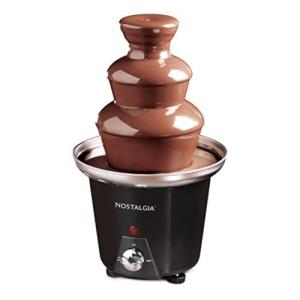
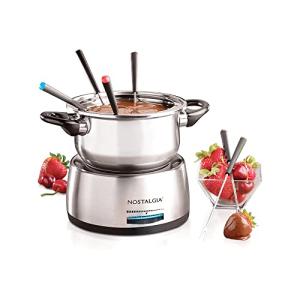
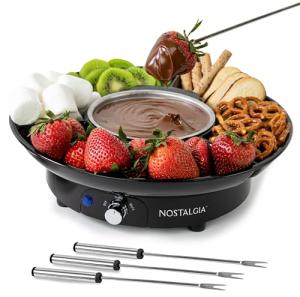
The smallest and most accessible of the three types. Chocolate fondue sets are often sold as miniature versions — tiny ceramic pots over tea lights, or purpose-built electric chocolate warmers. Temperature control is critical: chocolate burns at a surprisingly low point, and overheated chocolate becomes grainy and unworkable.
A good chocolate fondue set will have a low, consistent heat output and a wide, shallow pot that's easy to dip into. Double-boiler inserts that sit over a water bath are the most foolproof setup for beginners.
What to Look for in a Fondue Set
Material: Ceramic for cheese. Stainless steel for oil. Either for chocolate, though ceramic or cast iron with good temperature control is preferable.
Burner type: Spirit burners (burning methylated spirits or fondue fuel) give a controllable, moderate flame. Gel fuel canisters are convenient but less adjustable. Electric is the safest and most consistent option for all types.
Fork design: The long, color-coded forks are not an affectation — they're functional. The color coding means no one spends ten minutes arguing over whose fork is whose. Look for sets with at least 6 forks, ideally 8.
Stand stability: A fondue pot full of hot oil is a significant safety consideration. The stand must be wide-based, non-tipping, and heat-resistant.
The Best Fondue Sets on the Market
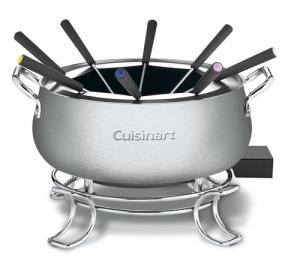
Cuisinart CFO-3SS Electric Fondue Maker — The electric fondue set that has converted countless people who were skeptical of the whole enterprise. Stainless steel interior, 1,000 watts, a temperature dial that actually works, and eight color-coded forks. Does cheese, oil, and chocolate without switching equipment. The size (3-quart capacity) is appropriate for 4–6 people.
Staub Cast Iron Fondue Set — For those who want the thing to look as good as it performs. Staub's enameled cast iron is as beautiful as it is functional, and the pot doubles as a serving vessel for stews, soups, and braises when fondue season ends. Expensive, but built to last generations.
Trudeau Ceramic Fondue Set — A well-made, mid-range option with a ceramic pot and spirit burner. Excellent for cheese fondue; adequate but not ideal for oil. Good value and a clean aesthetic that doesn't look embarrassing on a modern table.
The Fondue Rules That Actually Matter
Rub the pot with a cut clove of garlic before adding anything. Add white wine — never milk, never cream, never water. Grate your cheese fresh; pre-shredded cheese contains anti-caking agents that cause separation. Keep a tablespoon of cornstarch in reserve. Stir in a figure-eight motion, not circles. If it separates, a splash of lemon juice and vigorous stirring usually saves it.
If the bread cube falls off your fork into the pot, you owe the table a round of drinks. This is non-negotiable.
Crepe Makers — The Underrated Appliance That Earns Its Counter Space
Why Crepes Deserve More Serious Attention
The crepe is the most unfairly underestimated food in French cuisine. It is simultaneously a street food staple and a restaurant showpiece. It can be breakfast, lunch, dinner, or dessert. It requires almost no ingredients and an almost embarrassing amount of skill — or the right equipment.
A dedicated crepe maker changes the equation completely. The round, flat, thermostatically controlled surface eliminates the two biggest problems home cooks face with crepes: inconsistent heat and the wrong pan surface. A proper crepe maker gives you a flat, precisely heated, non-stick surface at the exact right temperature, every time.
Electric vs. Stovetop Crepe Makers
Electric Crepe Makers
The most common type for home use. A round, low-rimmed heating plate — typically 30–38cm in diameter — with a thermostat, a wooden or silicone spreading tool (called a rozell or T-spreader), and a thin spatula for flipping.
The key feature is temperature consistency. A good electric crepe maker heats to 190–200°C and holds that temperature whether you're making your first crepe or your twentieth. This is what makes the difference between crepes that tear and bubble unpredictably and crepes that lift cleanly and cook in under two minutes.
Stovetop Crepe Pans
Cast iron or carbon steel pans designed specifically for crepes. Lower investment, better for people with limited storage space, and can be used on any heat source including induction. The learning curve is steeper because temperature management requires attention and practice. Carbon steel is the professional's choice — it seasons over time and becomes more non-stick with use.
What to Look for in an Electric Crepe Maker
Plate diameter: Larger is more versatile. A 30cm (12-inch) plate makes a decent crepe; a 38cm (15-inch) plate gives you something closer to what you'd get from a Breton crêperie. The larger plates also work for savory galettes and flatbreads.
Temperature range and control: The thermostat should reach at least 200°C and hold steady. Cheap models that overshoot and cycle wildly make consistent crepes impossible.
Spreading tool quality: The wooden T-spreader is what gives crepes their characteristic thin, even texture. It needs to be exactly the right width for the plate and have enough friction on the surface to spread without dragging. Many included spreaders are poorly sized; it's worth buying a quality replacement.
Cord management: A minor but real consideration. Crepe makers involve batter, which involves mess. A cord that drapes across the work area in the wrong direction becomes an accident in waiting.
The Best Crepe Makers Worth Owning
Cuisinart CPP-200 Round Classic Crepe/Pizzelle Maker — A reliable mid-range electric option with a 20cm plate that's better suited for dessert crepes than full-size galettes. Temperature control is adequate; surface quality is good. An honest, reliable machine for occasional use.
Staub Cast Iron Crepe Pan — If you're going the stovetop route, this is the benchmark. Heavy, beautifully seasoned after a few uses, induction-compatible, and built to outlast every other piece of equipment in your kitchen. Requires practice to use well. Rewards that practice extravagantly.
Lacor Professional Crepe Maker — The choice for serious home cooks who want restaurant-adjacent results. 38cm plate, serious thermostat, the kind of heavy-gauge aluminum that heats evenly across the entire surface. Used widely in professional catering. The size means it's not tucked away easily, but if crepes are a regular occurrence, it's the right tool.
The Batter Question
Classic French crepe batter is flour, eggs, milk, butter, and a pinch of salt. The proportions are important; the technique of resting the batter for at least 30 minutes (ideally two hours) is not optional. Rested batter relaxes the gluten, thins slightly, and produces a more tender, pliable crepe.
Buckwheat galettes — the savory Breton version made with 100% buckwheat flour — require a slightly different technique and a more seasoned surface. They're worth the extra effort; filled with ham, egg, and Gruyère (a complète), they are one of the most satisfying things you can cook on a flat surface.
Sweet fillings are effectively unlimited. Salted caramel and toasted almonds. Ricotta and lemon zest. Nutella and sliced banana — which you might dismiss as obvious until you're eating it at midnight over a crepe maker with friends.
Choosing Between Them — Or Not Choosing at All
Raclette vs. Fondue: The Real Difference
These are often grouped together as "cheese appliances," but they serve fundamentally different occasions.
Raclette is better for larger groups, longer evenings, and mixed dietary preferences. The grill surface handles non-cheese ingredients, which means the meal works for guests who aren't interested in loading up on cheese exclusively. It's also more forgiving for timing — guests eat at their own pace, loading and melting and scraping as they go.
Fondue is more intimate and more immersive. A fondue pot pulls people physically closer to the table, creates a shared focus, and has a natural endpoint when the pot empties. It's less adaptable to dietary restrictions but creates a more cohesive dining ritual.
Where Crepe Makers Fit
Crepe makers are the odd appliance out in this group — they're not specifically a social cooking tool in the same way. But they belong in this conversation because the best crepe-making occasions share the same spirit: unhurried, participatory, and anchored to a table rather than a kitchen.
A crepe station at brunch, with a selection of fillings, operates on the same logic as a raclette grill at dinner. It becomes the event. The food is the backdrop to the company.
The Care and Keeping of All Three
Raclette Grills: The cheese trays are the highest-maintenance component. Clean them while still warm with a soft cloth — dried, baked-on raclette is difficult to remove without scratching the surface. The grill plate can be removed and washed; stone surfaces should be wiped down and kept dry to prevent cracking.
Fondue Sets: Cheese residue is best removed with hot water and a wooden spatula while the pot is still warm. Never put enameled or ceramic fondue pots through a dishwasher. If oil is used, let it cool completely before handling. Filter and store good-quality frying oil; discard any oil that has darkened significantly or smells off.
Crepe Makers: Non-stick surfaces should never meet metal utensils. Clean gently with a damp cloth after the surface cools — no soap necessary on well-seasoned surfaces. Store the spreading tool on the surface to prevent warping.
The Bigger Point
There's a reason these appliances have endured through multiple cycles of kitchen trends while more technologically sophisticated gadgets have come and gone. They are not primarily about cooking efficiency. They are not about precision or convenience. They are about the table as a place where something happens.
Every raclette dinner, every fondue gathering, every crepe breakfast is a small argument for slowing down — for a meal that takes two hours instead of thirty minutes, that requires participation rather than just consumption, that turns the ordinary act of eating together into something worth remembering.
That is, in the end, what good equipment enables. Not just better food. Better evenings.
Whether you're building a kitchen for serious entertaining or simply looking for a way to make Tuesday night feel like an occasion, one of these three appliances will earn its place. The only question is which one to start with — and the answer, honestly, is whichever one your friends are most likely to stay up late for.