There's a particular kind of kitchen anxiety that strikes when you open a cabinet and an avalanche of mismatched cookware tumbles out at you. A scratched non-stick pan you bought in college. A pot with no lid. A skillet that wobbles on the burner like it's auditioning for a slapstick comedy. Sound familiar?
Here's the thing most home cooks learn eventually, usually after wasting money on 14-piece sets that came with six items they never touch: a well-equipped kitchen isn't about quantity. It's about having exactly the right five pieces of cookware that cover nearly every cooking scenario life throws at you.
Whether you're a first-time apartment dweller starting from scratch or a seasoned cook looking to pare down and invest wisely, this guide cuts through the noise. These are the five pots and pans that professional cooks, culinary school graduates, and food writers consistently agree belong in every kitchen — and why each one earns its place.
Why Five? The Case for a Lean, Purposeful Cookware Collection
Before getting into the list, it's worth addressing a common impulse: more must be better. Cookware companies certainly want you to believe that. But every piece you own has to be stored, cleaned, maintained, and pulled out when you need it.
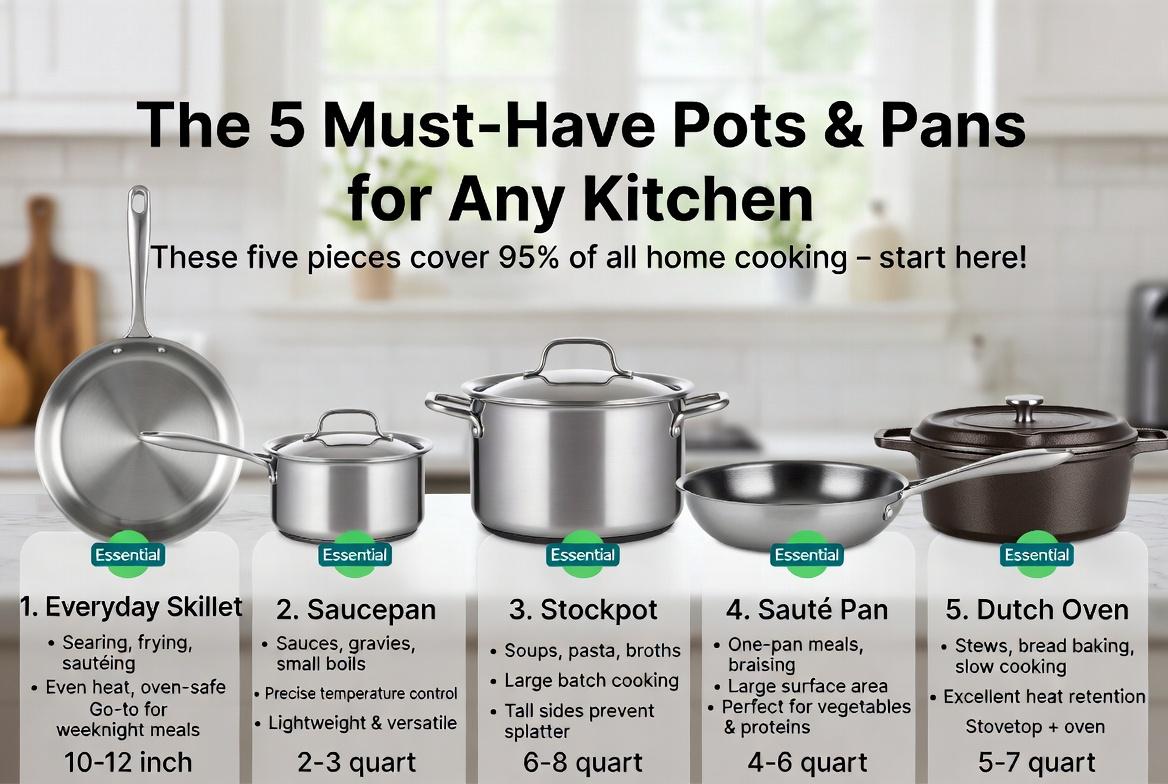
The five pieces below are chosen because they don't overlap. Each one does something the others genuinely cannot. A 12-inch skillet handles tasks that a sauté pan cannot match, and a Dutch oven goes places a saucepan simply cannot follow. Together, they form a complete system — one that handles breakfast, dinner, soups, braises, sauces, pastas, sears, and everything in between.
Think of this as your cookware starting lineup, not a bench of substitutes.
1. The 10- or 12-Inch Stainless Steel Skillet — Your Most Versatile Workhorse
If you could only own one pan — and some minimalists genuinely do — the stainless steel skillet is the one to pick. It's the pan that gets used daily in professional kitchens, the one chefs grab instinctively, and the one that rewards cooks who learn to use it well.
What Makes It Indispensable
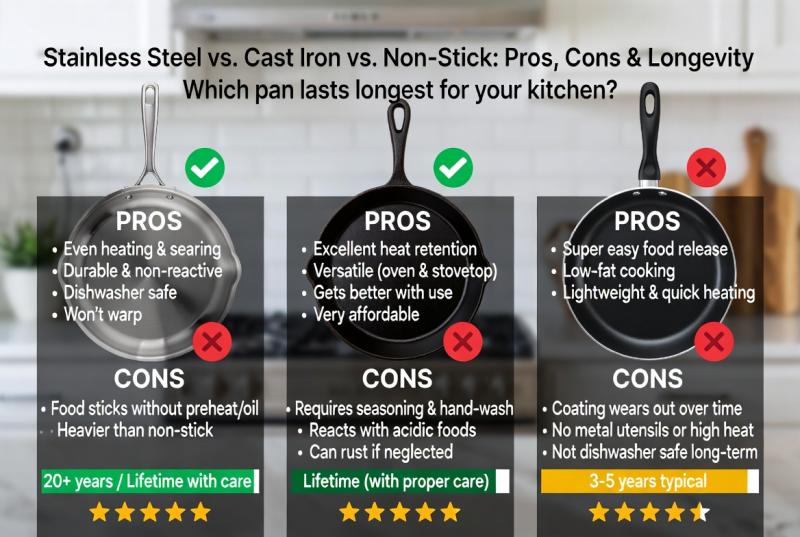
Stainless steel can handle high heat without complaint. It goes from stovetop to oven without issue. It builds a proper fond — those browned bits stuck to the pan after searing meat — which becomes the foundation of pan sauces that elevate a weeknight dinner into something genuinely impressive. It's safe with metal utensils, dishwasher-friendly in most cases, and with proper care, it will outlast every other pan in your kitchen by decades.
The learning curve is real. New stainless steel users often complain that food sticks. The fix is almost always the same: preheat the pan properly, use enough fat, and let the protein naturally release from the surface before trying to move it. Once you understand this, the stainless steel skillet becomes second nature.
What to Cook in It
- Searing chicken thighs, pork chops, steaks, and fish fillets
- Sautéing vegetables — onions, mushrooms, asparagus
- Building pan sauces with butter, wine, stock, and aromatics
- Frittatas (stovetop-to-oven in one pan)
- Shallow frying
- Cooking eggs, once you've got the heat management dialed in
What to Look For When Buying
Go for fully clad stainless steel — meaning the aluminum or copper core runs the full length of the pan, not just the bottom disc. This distributes heat more evenly and eliminates hot spots. Brands like All-Clad, Made In, and Tramontina's tri-ply line are consistently praised for quality at various price points.
A 12-inch pan is the most versatile for most households. A 10-inch works if you typically cook for one or two.
2. The Cast Iron Skillet — The Pan That Gets Better With Age
Cast iron has been with us for centuries, and for good reason. No other material retains heat the way cast iron does, and no other pan develops a natural non-stick surface through use. Every time you cook with it, you're building seasoning — polymerized layers of fat that accumulate over years into a slick, almost glass-like surface that needs no chemical coating to perform.
What Makes It Indispensable
The heat retention of cast iron is unmatched. Where stainless steel responds quickly to temperature changes (useful for delicate sauces), cast iron holds its temperature even when cold food hits the surface. That's exactly what you want when searing a thick steak or getting a proper crust on a piece of salmon. The pan doesn't flinch.
Cast iron also handles extreme heat well. You can put it under a broiler, into a 500°F oven, onto a gas burner, or over a campfire. It's extraordinarily durable — many cooks inherit their cast iron from parents or grandparents and pass it on again.
What to Cook in It
- Steaks and burgers (the sear is unbeatable)
- Cornbread and skillet cookies baked directly in the pan
- Fried chicken
- Hash browns and roasted potatoes
- Pan pizza with a crispy, burnished crust
- Roasted chicken, finished in the oven after browning on the stovetop
- Dutch babies and oven pancakes
What to Look For When Buying
Lodge is the gold standard for affordable, reliable cast iron — and it's made in the USA. A 10-inch or 12-inch skillet covers most bases. Avoid enameled cast iron for this category; a plain cast iron skillet is what delivers the cooking properties described above.
Maintenance is simple: wash with warm water and a brush (a small amount of soap occasionally is fine, despite old myths), dry it thoroughly, and rub a light coat of neutral oil over the surface while it's still warm.
3. The 3- to 4-Quart Saucepan — Small Pan, Outsized Importance
The saucepan is quiet. It doesn't inspire the kind of reverence that cast iron does, and it doesn't have the visual drama of a Dutch oven. But try going a week without one and you'll quickly realize how often you reach for it.
What Makes It Indispensable
The saucepan's shape — taller sides, relatively small base, with a lid — is designed for liquid-based cooking where you need controlled, even heat and manageable evaporation. It's the pan that turns out consistently good rice, smooth béchamel, silky custards, and properly reduced sauces. Its size is intentional: big enough to make a meaningful batch of something, small enough to maintain precise heat control.
What to Cook in It
- Rice, grains, lentils, and other stovetop starches
- Sauces — béchamel, hollandaise, caramel, tomato
- Boiling eggs
- Reheating soups and stews
- Steaming small portions of vegetables (with a steamer insert)
- Making hot drinks, oatmeal, and stovetop porridge
- Blanching small batches of vegetables
- Tempering chocolate
What to Look For When Buying
The same fully clad stainless steel construction recommended for the skillet applies here. A 3-quart saucepan is the sweet spot for most households — it's large enough to make rice for four people but small enough to reduce a cup of sauce without burning it. Look for a tight-fitting lid and a handle that stays cool on the stovetop.
Avoid cheap saucepans with thin bottoms. They heat unevenly and scorch delicate sauces. This is one category where spending a bit more makes a noticeable difference in day-to-day cooking.
4. The 5- to 7-Quart Dutch Oven — The Pan That Does It All, Slowly
A good Dutch oven is the one piece of cookware that confidently crosses every category. It's a pot, a braiser, a bread oven, a deep fryer, a soup pot, and a slow cooker rolled into one heavy, beautiful package.
What Makes It Indispensable
The Dutch oven's thick walls and tight-fitting lid create an almost oven-like environment inside the pot. Moisture recirculates rather than escaping, which keeps braises tender and soups rich without constant attention. The sheer mass of the pot holds heat evenly and for a long time, making it ideal for anything that benefits from low-and-slow cooking.
Enameled cast iron — the material most Dutch ovens are made from — is also versatile in ways that raw cast iron isn't. It's non-reactive, meaning it's safe for acidic foods like tomatoes, wine-based sauces, and lemon. The enamel also makes cleanup easy and requires no special seasoning.
What to Cook in It
- Braised short ribs, pot roast, lamb shanks, and coq au vin
- Soups and stews of every variety
- Crusty no-knead bread (the Dutch oven mimics a professional steam oven)
- Chili and bean dishes
- Deep frying (the high walls contain splatter; the thick base controls oil temperature)
- Pasta in large quantities
- Whole roasted chicken
- Pulled pork and long-cooked carnitas
What to Look For When Buying
Le Creuset and Staub are the premium options — they're expensive but extraordinary, and they genuinely last forever. Challenger Breadware makes excellent alternatives for bread bakers specifically. Budget-conscious cooks will find that Lodge's enameled Dutch ovens offer serious performance at a fraction of the price.
A 5-quart Dutch oven handles most tasks. If you regularly cook for more than four people or bake large loaves of bread, size up to 6 or 7 quarts.
5. The Non-Stick Skillet — The One Time Non-Stick Is Worth It
Non-stick cookware gets a complicated reputation in serious cooking circles. It can't handle high heat. Metal utensils will scratch it. It needs replacing every few years. All of that is true. And yet, a quality non-stick skillet still belongs in every kitchen — for one very specific reason.
What Makes It Indispensable
Eggs. The non-stick skillet exists primarily to cook eggs with minimal fat and zero drama. A soft scramble, a perfectly folded French omelette, a fried egg with a set white and a runny yolk — these are things that work in non-stick and are genuinely difficult in any other pan. Beyond eggs, non-stick is also ideal for delicate fish fillets that would stick to stainless steel, pancakes and crêpes, and any other situation where you want food to release cleanly without a lot of fat or fuss.
The key with non-stick is to accept it for what it is: a specialized tool, not a workhorse. Use it at medium to medium-low heat. Avoid metal utensils. Hand wash it. And plan to replace it every two to four years, because the coating will eventually degrade regardless of how well you treat it.
What to Cook in It
- All egg preparations: scrambled, fried, omelettes, eggs en cocotte
- Crêpes and thin pancakes
- Delicate white fish fillets (sole, flounder, tilapia)
- Sautéed tofu
- Quesadillas and thin flatbreads
What to Look For When Buying
A 10-inch pan is the ideal size for egg cooking — large enough for a two or three-egg omelette, small enough to control. Look for PFAS-free or ceramic non-stick coatings if you prefer to avoid traditional Teflon-type surfaces, though note that ceramic coatings tend to have a shorter lifespan. Brands like GreenPan, Caraway, and OXO offer well-reviewed options in both categories.
The Complete Picture — What These Five Pieces Cover Together
Let's map it out plainly. With these five pieces, you can handle:
Weeknight dinners: The stainless steel skillet sears your protein. The saucepan cooks your grain or sauce. The non-stick handles eggs on a lazy Tuesday.
Weekend projects: The Dutch oven braises short ribs low and slow. The cast iron bakes your cornbread or skillet cookie.
Batch cooking: The Dutch oven makes enough soup or chili for the week. The saucepan reduces a sauce to pour over everything.
Entertaining: The cast iron goes to the table sizzling with a protein. The Dutch oven delivers bread that looks like it came from a bakery.
There is no meal, no cuisine, and no technique that this collection cannot handle. Stir-fry? The screaming hot stainless steel or cast iron skillet. Risotto? The Dutch oven or saucepan, stirred patiently. Fried chicken? The cast iron skillet or Dutch oven, depending on volume. Custard? The saucepan, over gentle heat.
A Note on Materials, Heat Sources, and Induction Compatibility
One practical consideration often overlooked when buying cookware: induction compatibility. Induction stovetops require cookware with magnetic bases — stainless steel and cast iron are both induction-compatible. Most enameled Dutch ovens are as well.
Ceramic non-stick varies by brand, so check before purchasing. If you're cooking on gas or electric coil, all five of these pieces work without issue.
Also worth knowing: none of these five pieces require a matching set. Buy them individually, from different brands if necessary, based on what fits your budget and cooking style. A beautiful Le Creuset Dutch oven paired with a Lodge cast iron skillet and a Tramontina saucepan is a perfectly sensible kitchen. The pieces don't need to coordinate aesthetically to work well together.
How to Build This Collection Without Spending a Fortune
If buying all five at once isn't realistic, here's a sensible acquisition order:
Start with the stainless steel skillet. It's the most versatile piece and will cover more cooking scenarios than anything else on this list.
Add the non-stick skillet next. Eggs are daily. This earns its place quickly.
Get the saucepan third. Rice, sauces, and reheating — you'll use it constantly.
Bring in the Dutch oven when your budget allows. This is the most expensive piece but also the most transformative. It opens up an entirely different style of cooking.
Finish with the cast iron skillet. It's the least urgent addition, but once you have it, you'll use it all the time.
Budget-minded cooks can build this entire collection for under $200 by choosing mid-range options from Tramontina, Lodge, and similar brands. Cooks who want to invest once and never buy again can spend significantly more on All-Clad, Le Creuset, and Staub — and those pans may genuinely outlast their owners.
Final Thoughts — Own Less, Cook Better
The best thing that happens when you pare your cookware down to five essential pieces is that you stop wasting time choosing and start cooking. You know where everything is. You know what each piece does. You stop reaching for the wrong pan and wondering why the result isn't right.
There's a deeper lesson embedded in a good cookware collection. It's not just about equipment — it's about understanding what you're cooking and why. When you know that a sear requires dry heat and a tight contact surface, you reach for stainless steel or cast iron. When you need to build moisture and deepen flavor over hours, you reach for the Dutch oven. When you want a flawless omelette in two minutes, you reach for non-stick.
These five pans will teach you to cook if you let them.
And if you find yourself at a garage sale one day, eyeing a dusty cast iron skillet for three dollars — take it home. Season it, restore it, and add it to your collection. That pan has already outlasted whoever owned it before, and with a little care, it will outlast you too.