Types of Kitchen Thermometers
The thermometer category has expanded dramatically in recent years. What was once a simple dial probe has evolved into a diverse range of tools, each suited to different cooking styles and needs.
Instant-Read Thermometers
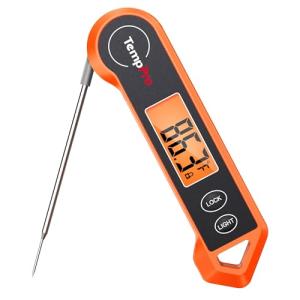
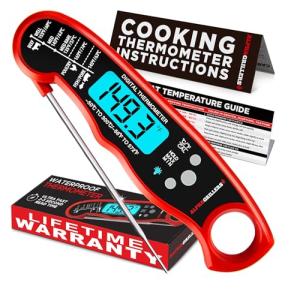
These are the most popular and versatile thermometers for home kitchens. As the name suggests, they give you a temperature reading in seconds — typically between one and five seconds for digital models. You insert the probe into your food, glance at the display, and you know exactly where you stand.
Instant-read thermometers are ideal for checking the doneness of steaks, chicken breasts, pork chops, and fish. They're also surprisingly useful for baking — checking that a loaf of bread has reached the right internal temperature, or that your candy syrup has hit the hard-crack stage. The best models feature a folding probe (which protects the tip and makes storage easy), a rotating backlit display so you can read it at any angle, and a probe that's at least four inches long to keep your hands safely away from heat.
Digital instant-read thermometers use either a thermocouple or thermistor sensor. Thermocouples are faster and better for very high or very low temperatures; thermistors are often more accurate in the mid-range cooking temperatures most home cooks use. For most people, the practical difference is small — what matters most is speed, accuracy, and build quality.
Leave-In Probe Thermometers
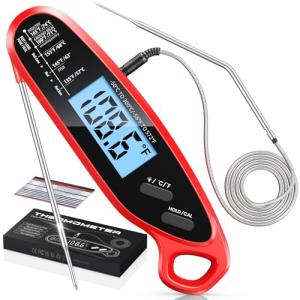
If you regularly roast large cuts of meat — whole chickens, pork loins, leg of lamb, prime rib — a leave-in probe thermometer is worth every penny. Unlike instant-read models, these stay inside the food throughout cooking. The probe connects to a base unit via a heat-resistant cable, and the display sits on your counter (or magnetizes to your oven). You set a target temperature, walk away, and the unit alerts you when your roast hits the mark.
The best leave-in thermometers also include a countdown timer, high and low temperature alarms, and some can track multiple probes simultaneously — useful when you're cooking two proteins at different target temperatures. This category is particularly helpful for low-and-slow cooking methods like smoking or slow roasting, where internal temperature is everything and you can't afford to keep opening the oven door to check.
Wireless and Bluetooth Thermometers
This is the fastest-growing segment of the category, and for good reason. Wireless thermometers free you from hovering over the oven. The probe goes into your food, and temperature data streams to your smartphone via Bluetooth or Wi-Fi. You can monitor your cook from the living room, the backyard, or even a few miles away if you have a Wi-Fi-enabled model.
Smart wireless thermometers often come with companion apps that guide you through the cooking process: select your protein, choose your preferred doneness level, and the app tells you not just the current temperature but an estimated time to completion. Some advanced models feature multiple sensors along the probe, measuring the temperature at the core and near the surface simultaneously, giving you a complete picture of how heat is moving through your food.
These tools are especially popular for BBQ and grilling enthusiasts who need to monitor a slow-smoked brisket over several hours without constant checking.
Oven Thermometers
Your oven's built-in temperature display is often less accurate than you'd expect. A dial that reads 200°C might actually be running 15 or 20 degrees hotter or cooler. Over time, that inconsistency silently sabotages your baking. Oven thermometers are simple, inexpensive tools — usually a small dial or digital unit — that hang from an oven rack and show you the actual air temperature inside your oven.
Once you know your oven's true behavior, you can adjust your cooking temperatures accordingly. This is particularly important for delicate bakes like meringues, pastries, and cakes, where temperature precision is critical.
Candy and Deep-Fry Thermometers
These specialized thermometers are built for extreme temperatures — typically measuring up to 300°C or higher. Candy-making requires hitting very specific temperature stages: soft ball, hard ball, soft crack, hard crack. Each stage corresponds to a precise temperature range, and missing it by even a few degrees changes what you end up with. Deep-frying requires oil to be at the right temperature for food to cook properly without absorbing excess fat.
These thermometers typically feature a long probe and a clip to attach them to the side of the pot, and many include helpful temperature stage markers printed directly on the display.
Infrared Thermometers
Infrared thermometers measure surface temperature without contact — just point and shoot. They're useful for checking the temperature of a pan or griddle before adding food, ensuring your cast iron is properly preheated, or testing the temperature of a pizza stone. They don't measure internal food temperature, so they're a complement to, not a replacement for, probe thermometers.
Types of Kitchen Timers
A timer might seem like the simpler side of this category, but there's more variety here than most people realize.
Digital Countdown Timers
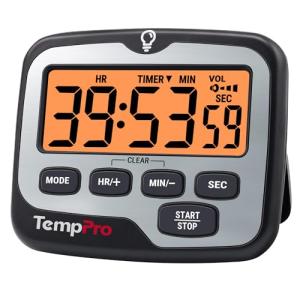
The classic kitchen timer, now in digital form. Set your countdown, press start, and a loud alarm tells you when time is up. The best digital timers feature large, easy-to-read displays, magnetic backs so you can stick them to the fridge or oven, and alarms loud enough to hear from another room. Look for models with a simple interface — in the middle of cooking, you don't want to be hunting through menus to set a 12-minute timer.
Multi-Channel Timers
If you regularly cook multiple dishes simultaneously — which most weeknight dinners require — a multi-channel timer is a game-changer. These units run two, three, or even four separate countdowns at once, each with an independent alarm. You can track your roasting vegetables, your pasta water, and your sauce all at the same time without mental gymnastics or sticky notes on the counter.
Mechanical Timers
Old-fashioned twist-and-tick timers still have a devoted following, and for good reason. They require no batteries, no setup, and no buttons — just wind the dial to the desired time. They're reliable, satisfying to use, and essentially indestructible. The trade-off is that they're less accurate than digital timers and typically max out at 60 minutes.
Combination Thermometer-Timer Units
Many modern cooking thermometers now include built-in timers, merging both functions into a single device. This is practical and reduces counter clutter. You get the probe for temperature monitoring alongside a countdown timer and alarm — perfect for oven roasting where you want to track both cooking time and internal temperature simultaneously.
What to Look for When Buying
Accuracy and Response Time
These are non-negotiable. A thermometer that reads a few degrees off — consistently — will lead you astray every single time. Look for models that specify their accuracy (±1°C or better is good; ±0.5°C is excellent). Speed matters too, especially for instant-read models: a thermometer that takes ten seconds to stabilize is annoying and potentially inaccurate if you're moving the probe around.
Probe Length and Build Quality
A probe shorter than 10cm forces your hand uncomfortably close to hot food. Longer probes are safer and can reach the center of large roasts or deep pots of oil. Check that the probe and cable (for leave-in models) are rated to handle the temperatures you'll expose them to. Heat-resistant cables are essential for oven use.
Display Clarity
A backlit display that auto-rotates based on how you're holding the thermometer sounds like a small luxury, but in a busy kitchen — especially when you're leaning over a hot oven — being able to read the number instantly and at any angle genuinely matters.
Waterproofing and Durability
Kitchens are wet, greasy, and chaotic. An IP-rated waterproof thermometer can be rinsed under the tap without worry, which is both practical and important for food hygiene. If a thermometer can't be properly cleaned, it's a food safety concern.
Timer Loudness
A timer alarm that you can't hear from the next room isn't doing its job. Check reviews for real-world feedback on alarm volume — some units look great on paper but produce an anemic beep that gets lost in kitchen noise.
Using Thermometers Safely and Accurately
Getting accurate readings requires a bit of technique. For meat, insert the probe into the thickest part of the cut, away from bone, fat, and gristle — all of which conduct heat differently than muscle tissue and will give you a misleading reading. For thin cuts like chicken fillets or pork chops, insert the probe sideways along the length of the cut rather than straight down.
Always allow meat to rest before serving — temperatures continue to rise slightly after you remove food from the heat (called carryover cooking), so pulling it a few degrees below your target and letting it rest produces a better result than cooking all the way to your exact target temperature.
For oven thermometers, don't just check the temperature once when it's preheated. Ovens cycle their heating elements on and off, so temperature fluctuates throughout a bake. Taking a running average over 15 minutes gives you a more accurate picture of your oven's true performance.
Food Safety: The Practical Reason Everyone Should Own a Thermometer
Beyond cooking quality, thermometers are a food safety tool. The only reliable way to know that chicken, pork, ground beef, or seafood has reached a safe internal temperature is to measure it directly. Visual cues — clear juices, firm texture, golden color — are not reliable indicators of doneness. A digital thermometer takes the uncertainty out of the equation entirely.
Timers play a supporting role here too: food that cooks for the right amount of time at the right temperature is both safe and delicious. The two tools work best together.
Choosing the Right Products for Your Kitchen
If you're building out your kitchen toolkit, a good instant-read thermometer is the single most impactful purchase you can make in this category. It's useful every day, for almost every type of cooking. From there, a simple digital countdown timer and a leave-in probe thermometer for roasting cover the vast majority of home cooking needs.
If you grill, smoke, or do a lot of large-format cooking, a wireless Bluetooth thermometer unlocks a new level of convenience and consistency. And if you bake seriously, an oven thermometer is a small investment that quietly fixes a lot of problems you might not even know you have.
However you cook, the right thermometer and timer remove the guesswork and replace it with confidence. And confident cooking almost always tastes better.