What Makes a Steak Knife a Steak Knife
At its most basic, a steak knife is a sharp, pointed table knife designed specifically for cutting cooked meat. But that description doesn't quite capture what a good one actually does. A proper steak knife is engineered for a very specific task: producing clean, effortless cuts through protein that has already been rested and plated, without tearing, shredding, or requiring you to exert real force.
The blade is typically between 4 and 5 inches long — long enough to handle a thick ribeye or a generous pork chop, short enough to feel controlled in the hand. The point is sharp and pronounced, useful for navigating around bones or trimming as you go. The edge itself is where things get interesting, and it's the single most important factor in how a steak knife performs.
Most steak knives fall into one of two categories: serrated or straight-edged. Both work, both have real advantages, and which you prefer often comes down to personal habit and how much you enjoy maintaining your knives.
Serrated vs. Straight Edge: The Real Difference
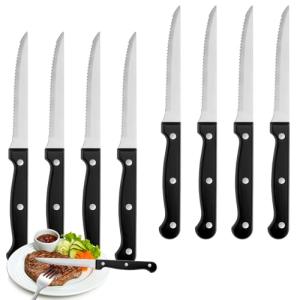
Serrated steak knives are the most common type you'll encounter, and for good reason. The micro-teeth along the blade edge act like tiny saw teeth, gripping the surface of the meat and pulling through it with each stroke. This means a serrated blade will cut reasonably well even as it dulls over time, which is part of why they're so popular in restaurants and as everyday tableware sets. They're forgiving, they're low-maintenance, and they work.
The downside is the cut itself. Because serrated blades saw rather than slice, they tear the meat fibers to some degree. Under a microscope — or a very critical eye — you'll see the difference at the cut surface. The meat loses a little juice at the edge, the texture is fractionally less clean. For most people eating a Tuesday-night dinner, this is completely undetectable. For serious home cooks who've spent time on a high-quality piece of beef, it matters.
Straight-edged steak knives, often called plain-edge or smooth-edge knives, slice rather than saw. A sharp straight blade produces a genuinely clean cut — the fibers separate rather than tear, the surface is smooth, and the meat loses less juice at the cut edge. The experience of eating is subtly but noticeably better. The catch is maintenance: a straight-edged blade dulls faster with regular use and needs periodic sharpening or honing to stay effective. If you're willing to take care of your knives, the reward is real.
Some manufacturers offer a middle-ground option — a micro-serrated or finely scalloped edge — that sits between the two. These hold their edge longer than a plain edge and cut more cleanly than a coarse serration. They're a sensible compromise for households that want performance without the commitment of regular sharpening.
Handle Materials: Comfort, Durability, and the Way It Feels
The handle of a steak knife matters more than people usually expect. You're not gripping it with power-grip intensity the way you might a chef's knife during prep work, but you're using it for the duration of a meal — making dozens of small cuts, picking it up and setting it down, passing it around the table. A handle that feels good makes the experience better in a way that's hard to articulate but easy to notice.
Wood handles are perennially popular for a reason. They feel warm in the hand, they look beautiful on a table, and they have a natural grip that feels intuitive. Hardwoods like walnut, olive, pakkawood, and rosewood are commonly used. The trade-off is care — wood handles generally shouldn't go in the dishwasher, and they may need occasional oiling to stay in good condition. For people who treat their cutlery well, this is no hardship. For households that throw everything in the dishwasher without thinking twice, wood handles may not be practical.
Synthetic and resin handles — often sold under names like POM, G-10, Micarta, or various proprietary composites — are the practical workhorses of the steak knife world. They resist moisture, don't shrink or crack, and are almost always dishwasher-safe. Modern synthetic handles can be made to feel remarkably good in the hand, and they're available in a wide range of colors and finishes. They're less romantic than wood, but they're also less demanding.
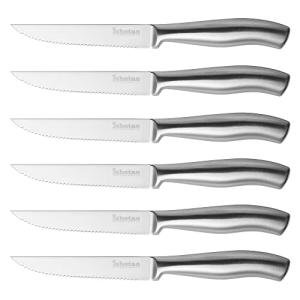
Stainless steel handles offer a seamless, modern look, particularly popular in contemporary kitchen design. A single-piece stainless knife has no joint between blade and handle, which means no crevice for food to hide. They're easy to clean and virtually indestructible. The downsides: they can feel heavy, they conduct cold from the table, and the grip can be slippery when wet unless the handle has been textured.
Bone and horn handles appear on higher-end and artisan sets, bringing genuine character and uniqueness. Each piece is slightly different. They require more care than synthetics but offer a connection to traditional craftsmanship that some people find worth the effort.
Blade Steel: What's Actually in the Knife
Most mass-market steak knives are made from stainless steel in one form or another, which is a broad category. Not all stainless is created equal.
The steel's hardness (measured on the Rockwell scale) determines how sharp the knife can get and how long it holds that edge. Softer steels are more resistant to chipping but lose sharpness faster. Harder steels hold an edge longer but can be brittle and are less forgiving of rough treatment. For a steak knife, a mid-range hardness is usually ideal — you want a blade that sharpens easily, holds its edge through repeated use, and doesn't require treating it like a museum artifact.
High-carbon stainless steel is the sweet spot for most quality steak knives. It combines the rust-resistance of stainless with improved edge retention from the carbon content. German stainless steels (such as X50CrMoV15) and Japanese steels (such as VG-10 or AUS-10) both appear in quality steak knife sets, each with a slightly different character. German steels tend to be slightly softer and easier to maintain; Japanese steels tend to be harder, holding a finer edge but sometimes requiring more careful treatment.
For everyday steak knives that will be used regularly and washed without obsessing over them, a good German-style stainless steel is an excellent choice. For cooks who want exceptional sharpness and are willing to care for their knives properly, Japanese steel offers a noticeable step up.
Full Tang vs. Partial Tang: Why It Matters
The "tang" is the part of the blade that extends into the handle. A full-tang knife has the steel running the entire length of the handle, usually visible as two strips of metal along the sides. A partial tang extends only partway.
For steak knives, this is less critical than for a chef's knife that takes heavy daily use, but it still matters for durability and balance. Full-tang knives are more robust and tend to have better balance. They also signal quality — manufacturers who use full-tang construction are generally more serious about the overall product. Partial-tang knives aren't automatically inferior, but they're more common in budget sets and tend to be less durable over years of use.
Sets vs. Individual Knives
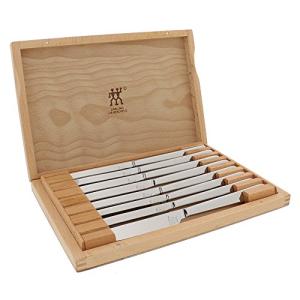
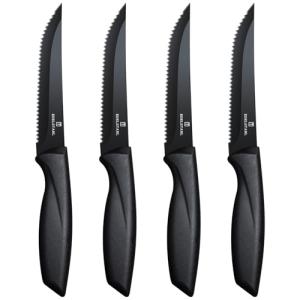
Most steak knives are sold in sets — typically four, six, or eight knives, sometimes with a storage block or case. For most households, buying a set is the sensible approach. You want a matched collection, and sets are almost always more economical than buying individually.
The question is set size. A set of four works for a couple or a household that entertains occasionally and rarely hosts large dinners. A set of six covers most real-world dinner party scenarios comfortably. A set of eight is ideal for households that regularly host or have a larger family. There's no harm in buying a larger set than you think you need — you'll find occasions to use the extra knives, and having them already matched is much easier than trying to find identical replacements later.
Some manufacturers also offer open-stock options, meaning you can buy individual knives to expand a set or replace one that's been damaged. This is worth checking before you commit to a brand, especially if you're investing in something at the higher end of the market.
How to Care for Your Steak Knives
Good steak knives last for decades with basic care. The main enemies are the dishwasher, prolonged moisture, improper storage, and cutting on hard surfaces.
The dishwasher is the biggest villain. The combination of harsh detergent, high heat, and jostling against other utensils dulls edges faster, damages handles, and can cause spotting or corrosion on even stainless steel blades. Hand washing with mild soap and immediate drying is always better. It takes thirty seconds and makes a measurable difference over the life of the knife.
Storage matters too. Throwing steak knives loosely into a drawer causes them to knock against each other and other utensils, dulling the edges. A knife block, a magnetic strip, or individual blade guards keep edges protected. Many steak knife sets come with a wooden storage block or a presentation box that doubles as practical storage.
For straight-edge knives, periodic honing and occasional sharpening keeps them performing at their best. A simple honing steel or ceramic rod used every few uses keeps the edge aligned. Actual sharpening — removing metal to restore a new edge — is needed less often, perhaps once or twice a year with regular use.
Serrated knives are more complicated to sharpen at home and are usually best taken to a professional if they need it, or simply replaced if the set has seen many years of heavy use.
What to Look for When Buying
When you're shopping for steak knives, a few key things are worth looking at closely:
Balance is the feel of the knife in your hand — specifically, how the weight is distributed between blade and handle. A well-balanced knife doesn't feel heavy at either end. Pick it up (if you can) and make a few natural cutting motions. It should feel like an extension of your hand rather than a tool you're fighting.
Fit and finish tells you a lot about overall quality. Look at the joint between blade and handle — is it clean and flush, or is there a gap? Are the rivets (if any) smooth and even? Is the blade surface consistent? Small details in manufacturing reflect the care put into the overall product.
Comfort is personal. Handle thickness, shape, and texture all contribute. Some people prefer a slimmer handle; others like something more substantial. If buying online, it's worth reading reviews specifically about how the knife feels in the hand over a full meal, not just how it looks on first inspection.
Price point is a reasonable guide to quality, though diminishing returns kick in at the higher end. A well-made set at a mid-range price will outperform a budget set for years. At the premium end, you're paying for exceptional steel, artisan construction, or materials like hand-finished wood or forged blades — genuine value if you'll appreciate it, unnecessary if you just want reliable everyday cutlery.
Steak knives are one of those purchases that pays off quietly, meal after meal, for years. The right set turns an ordinary dinner into a more complete experience — not dramatically, not obviously, but in the way that good tools always do. When everything works the way it should, you simply stop noticing friction and start enjoying the thing itself.
Whether you're looking for a practical everyday set, a beautiful addition to a well-equipped kitchen, or a gift for someone who genuinely loves to cook and entertain, there's a steak knife set that fits. Take the time to find it. You'll use it more than almost anything else in your kitchen.