Skillets are a must-have in any kitchen, making cooking a breeze. Whether you're frying up eggs for breakfast or sautéing veggies for dinner, these versatile pans are your go-to. With a variety of materials and sizes, you'll find the perfect skillet to match your cooking style and needs.
Skillets
Discover versatile skillets that make cooking a breeze and elevate your culinary creations
Product List
What Makes a Skillet Different from Other Pans
Before diving into types and materials, it helps to understand what a skillet actually is. A skillet — sometimes called a frying pan — has a flat bottom, low to moderately sloped sides, and a long handle. Those sloped sides aren't accidental. They allow moisture to escape during cooking, which encourages browning rather than steaming. They also make it easy to flip, toss, and slide food without a spatula.
Compare that to a sauté pan, which has straight, taller sides and is designed to hold more liquid. Or a saucepan, which is deeper still. A skillet is purpose-built for high-heat cooking where contact between food and hot metal surface matters: searing a chicken thigh, crisping potatoes, getting a perfect crust on a piece of fish. It's a fundamentally different tool, and that's why it deserves its own thoughtful consideration.
Skillets come in a range of sizes — typically 8-inch, 10-inch, and 12-inch — with the 10- and 12-inch sizes being the most versatile for everyday cooking. Smaller pans are great for single servings or toasting spices; larger ones handle family-sized meals and dishes that need room to spread out without crowding.
The Five Main Types of Skillets
Nonstick Skillets
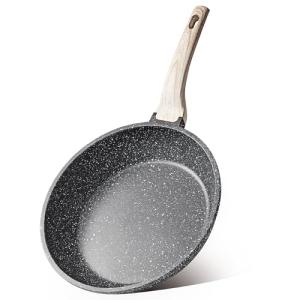
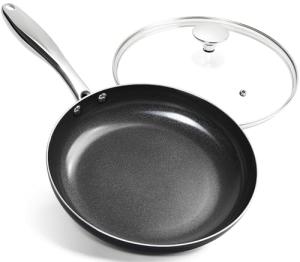
Nonstick skillets are the most popular choice for everyday home cooking, and it's easy to see why. Eggs slide out without breaking. Pancakes flip with a flick of the wrist. Fish fillets lift cleanly from the surface without tearing. Cleanup is fast — often just a wipe with a damp cloth.
The technology behind nonstick coatings has evolved significantly. Traditional PTFE coatings (the chemical family that includes Teflon) are still widely used and highly effective, but ceramic nonstick coatings have grown in popularity among cooks who prefer to avoid synthetic fluoropolymers. Ceramic coatings are typically made from inorganic minerals and marketed as free from PTFE and PFAS — the so-called "forever chemicals" that have drawn increasing scrutiny from health-conscious consumers.
The trade-off with nonstick, regardless of coating type, is durability. These pans don't last forever. The coating is sensitive to high heat, metal utensils, and abrasive cleaning. Treat a nonstick skillet gently — use silicone or wooden tools, hand wash when possible, and avoid cranking the burner to max — and it will serve you well for years. Push it beyond its limits and you'll be shopping for a replacement sooner than you'd like.
Nonstick skillets are not ideal for high-heat searing. The coating can't handle the extreme temperatures needed to develop a deep, caramelized crust on meat. For that, you need something more robust.
Cast Iron Skillets
Cast iron is the old soul of the skillet world. These pans have been around for centuries and, with proper care, they'll outlast everyone in your household. Some families pass them down through generations. That's not marketing copy — it's genuinely true.
What makes cast iron so special is its heat retention. Once a cast iron skillet comes up to temperature, it holds that heat with remarkable consistency. That's exactly what you want when searing a steak, frying chicken, or baking a skillet cornbread. It also transitions seamlessly from stovetop to oven, which opens up a whole range of cooking techniques — starting a dish on the burner and finishing it under the broiler, for instance, or baking a deep-dish pizza directly in the pan.
The downsides are real, though. Cast iron is heavy — a 12-inch pan can weigh five pounds or more — and it takes time to heat up evenly. It also requires a bit of maintenance. You'll need to keep it seasoned (essentially, a layer of polymerized oil baked into the surface) to prevent rust and build up a natural nonstick quality over time. And you should avoid soaking it in water or putting it in the dishwasher.
For cooks who are willing to put in that small amount of upkeep, cast iron is one of the most rewarding skillets you can own. For cooks who want something they can throw in the dishwasher and forget about, it might not be the right fit.
Stainless Steel Skillets
Stainless steel skillets are the professional kitchen standard for a reason. They can handle high heat without complaint, they don't react with acidic foods, they're dishwasher safe, and they'll look presentable for decades. If you've ever seen a professional chef deglaze a pan with wine and scrape up all those delicious browned bits into a sauce, that's a stainless steel pan doing what it does best.
The main thing first-time buyers need to understand about stainless is that food will stick — at least until you learn how to use it properly. The key is getting the pan properly hot before adding oil, then letting the oil heat before adding food. When done right, proteins will naturally release from the surface once they've formed a crust. When done wrong, you'll be scrubbing eggs off the bottom of your pan and wondering why you didn't just get a nonstick.
Stainless steel pans are usually constructed with a multi-layer (or "clad") design, bonding stainless steel to an aluminum core. Aluminum conducts heat much faster and more evenly than stainless alone, so this construction gives you the durability of stainless with the heating performance of aluminum. Fully-clad pans extend this layering up the sides of the pan, not just the base — a detail worth paying for.
Carbon Steel Skillets
Carbon steel is what you might call a hidden gem of the skillet world. It's been a staple in French restaurant kitchens for generations, but it's only recently caught on with serious home cooks. Think of it as a lighter, more responsive cousin to cast iron — made from the same basic material (iron and carbon), but thinner and therefore less heavy and faster to heat.
Like cast iron, carbon steel requires seasoning and will develop a beautiful, naturally nonstick patina with use. Unlike cast iron, it heats up quickly and responds to temperature changes faster, giving you more precise control. It's also lighter, which makes it easier to maneuver on the stovetop. Carbon steel pans are induction-compatible and fully oven-safe, making them a genuine all-rounder.
The learning curve is real — new carbon steel pans are reactive and prone to sticking until properly seasoned. Acidic foods can strip the seasoning. But for cooks who enjoy a bit of process and ritual with their cookware, carbon steel has a devoted following that rarely looks back.
Copper Skillets
Copper sits at the top of the performance hierarchy in terms of heat responsiveness. It heats up almost instantly and cools down just as fast, giving the cook exceptional control over temperature — particularly valuable for delicate sauces and precise cooking. This is why copper cookware has been the choice of elite French kitchens for centuries.
However, copper comes with a significant price premium and some notable care requirements. Most copper skillets are lined with stainless steel or tin on the interior to prevent the metal from reacting with food. They tarnish over time and need periodic polishing to maintain their appearance. For most home cooks, copper is more of a specialty or investment purchase than a daily-use workhorse.
What to Think About When Choosing a Skillet
How do you mainly cook? If eggs, fish, and pancakes are your daily staples, a quality nonstick skillet should be your starting point. If you're a meat-lover who regularly sears steaks and roasts, cast iron or stainless will serve you better. Many cooks end up owning one of each — a nonstick for delicate everyday cooking and a cast iron or stainless for high-heat work.
What cooktop do you have? Induction cooktops require magnetic materials — cast iron, carbon steel, and magnetic stainless steel all work. Standard nonstick aluminum pans do not, unless they're specifically designed with an induction-compatible base. If you cook on induction, check the specs before buying.
How much do you want to maintain your cookware? Stainless and nonstick are low-maintenance. Cast iron and carbon steel take a little more attention. Neither is difficult, but if you want to wash everything in the dishwasher and not think twice about it, stainless or a good quality nonstick is the practical answer.
What size do you actually need? A 10-inch skillet covers most cooking tasks for one to two people. Families or cooks who batch-cook should look at a 12-inch. An 8-inch is a handy secondary pan for single eggs, toasted spices, or small portions.
Caring for Your Skillet
No matter what material you choose, a few habits will extend the life of your skillet significantly.
Always let your pan cool down before washing it — plunging a hot pan into cold water can warp the base over time, creating uneven hot spots that persist permanently. For nonstick pans, use gentle cleaning tools and skip anything abrasive. For cast iron, dry it thoroughly after washing and apply a thin layer of oil before storing. For stainless, those stubborn browned residues come off easily with a soak and some baking soda — you don't need steel wool.
Store skillets in a way that prevents the cooking surface from being scratched. If stacking, place a cloth or paper towel between pans to protect the finish.
Building Your Skillet Collection
Most kitchens benefit from having more than one skillet, and you don't need to spend a fortune to build a functional collection. A practical starting point for most home cooks is a 10- or 12-inch nonstick skillet for everyday cooking and a 10- or 12-inch cast iron or stainless skillet for high-heat work. Together, these two pans cover almost every cooking scenario you'll encounter.
From there, you can add based on how your cooking evolves — a carbon steel pan if you want something lighter than cast iron with similar performance, a smaller nonstick for single-serving tasks, or a larger cast iron for batch cooking and entertaining.
The best skillet isn't necessarily the most expensive one. It's the one that fits how you actually cook, gets used every day, and becomes the kind of pan that feels like an extension of your hand. That's what this category is all about.