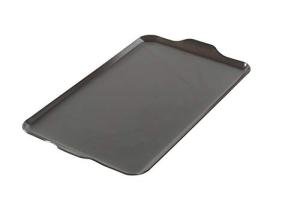
What Makes a Griddle Different?
At its core, a griddle is simply a flat cooking surface — but that simplicity is exactly what makes it so useful. Unlike a frying pan with sloped sides, or a grill with raised grates, a griddle gives you a wide, uninterrupted cooking area where heat distributes evenly and food sits flush against the surface.
This design creates a few practical advantages. First, you get better browning. When food makes full contact with a hot flat surface, the Maillard reaction — the chemical process behind that golden crust on a pancake or burger — happens faster and more consistently. Second, you can cook a lot at once. A standard home griddle can handle eight pancakes simultaneously without any of them suffering from hot spots or uneven heat. And third, grease and drippings flow off the surface toward a channel or drip tray rather than pooling under your food, which actually makes griddle cooking leaner than many people assume.
The open, flat surface also makes spatula work easy. You have room to maneuver, room to push food around, and room to set things aside to stay warm while you finish the rest of the meal.
Types of Griddles
Electric Griddles
Electric griddles are the most popular option for home kitchens, and it's easy to see why. They plug into a standard outlet, sit on the countertop, heat up quickly, and offer consistent, thermostat-controlled temperatures across the entire cooking surface. Most models have a built-in drip tray and removable plates for easy cleaning — some are even fully dishwasher-safe.
The temperature control on a good electric griddle is genuinely precise. You can dial in 375°F for pancakes, drop it to 300°F to keep sausages warm, or crank it up to 425°F for searing. This kind of predictability is hard to replicate on a stovetop.
Electric griddles come in a wide range of sizes, from compact single-person models about the size of a large plate, all the way up to large family-sized surfaces that span nearly two feet. If you cook breakfast regularly or entertain often, the larger surface is worth the counter space it requires.
Stovetop Griddles
Stovetop griddles are flat plates — usually cast iron or carbon steel — that sit directly over your stove burners. They're a practical choice if counter space is limited, since they don't require a dedicated spot and can be stored away when not in use. Many models are designed to span two burners at once, giving you a surprisingly large cooking area.
One thing to keep in mind: stovetop griddles work best on gas ranges, where the flame heats the surface more evenly. On electric coil stoves, you may notice uneven heating in the center versus the edges. On induction cooktops, you'll need a griddle made from a ferromagnetic material like cast iron or carbon steel that sits completely flush with the surface.
Stovetop griddles are also extremely portable — they're a natural fit for camping trips, outdoor cooking over a fire, or taking along to a holiday gathering where you want to put the stove to work.
Outdoor Gas Griddles
Outdoor gas griddles — the kind made famous by brands like Blackstone and Camp Chef — have become one of the fastest-growing categories in outdoor cooking. These are freestanding units that connect to a propane tank, feature large flat cooking surfaces (often 28 to 36 inches wide), and run on multiple burners that can be controlled independently.
The appeal is obvious once you've used one. You can cook for a large group without crowding anything. One side of the griddle can run hot for searing steaks while the other stays at a lower temperature for warming tortillas or keeping vegetables ready. The sheer cooking area means you're doing everything at once rather than in batches.
Gas griddles heat up faster than electric models and recover temperature quickly after you add cold food — a genuine advantage when cooking frozen items or large cuts of meat. They're also incredibly durable. A well-seasoned outdoor gas griddle can last for decades with minimal upkeep.
Panini and Press Griddles
These are double-sided griddles — a hinged top plate presses down onto the bottom surface, cooking food from both sides at once. They're most commonly associated with pressed sandwiches and paninis, but they're equally useful for cooking chicken breasts flat, toasting wraps, or browning quesadillas.
Press griddles dramatically cut cooking time since heat is applied from above and below simultaneously. Many models have both ridged and smooth plate options, so you can switch between getting grill marks on a steak and a perfectly smooth surface for eggs or French toast.
Griddle Plates and Accessories
At the simpler end of the spectrum, griddle plates are just flat cast iron or steel surfaces designed to sit over existing burners or be inserted into grill grates. They're inexpensive, effective, and remarkably versatile. If you already own a quality grill and don't want to invest in a dedicated flat-top, a griddle plate or insert lets you add a flat cooking surface without buying another appliance.
Griddle Materials — What's Cooking Your Food?
The surface your griddle is made from has a real impact on how it cooks and how much maintenance it requires.
Cast Iron is the traditional choice and still one of the best. It holds heat exceptionally well and distributes it evenly once it comes up to temperature. Cast iron griddles develop a natural non-stick surface through seasoning — a process of applying thin layers of oil and heating the pan repeatedly until a dark, slick patina forms. The tradeoff is weight: cast iron is heavy, and it requires a bit of care to keep it in good condition (no soaking, no harsh detergents, always dry it thoroughly after washing).
Carbon Steel behaves very similarly to cast iron but is lighter and more responsive to temperature changes. It's a favorite among professional cooks who want the seasoned non-stick surface of cast iron without the bulk. Carbon steel griddles season well and, once broken in, are genuinely a pleasure to cook on.
Aluminum with Non-Stick Coating is the most common material in household electric griddles. It's lightweight, heats up quickly, and requires almost no maintenance — eggs and pancakes slide right off without any seasoning needed. The tradeoff is longevity. Non-stick coatings do eventually wear down, especially if metal utensils are used or the surface is scrubbed aggressively. However, for everyday convenience at a reasonable price point, coated aluminum griddles are hard to beat.
Stainless Steel is the standard in commercial griddles. It's durable, easy to clean thoroughly, and handles heavy daily use without degrading. It's less naturally non-stick than cast iron or coated aluminum, but in a professional kitchen that's less of a concern — cooks use adequate oil and have the technique to manage it.
Chrome Griddle Surfaces are a premium option found in high-end commercial equipment. Chrome tops distribute heat extremely evenly, are very easy to clean, and are ideal for delicate items like eggs that can stick on rougher surfaces. They also retain heat efficiently, which can reduce energy costs in a busy kitchen.
Heat Source — Gas vs. Electric
The choice between gas and electric often comes down to your kitchen setup, but each has genuine strengths worth understanding.
Gas griddles heat up faster, recover temperature more quickly after adding cold food, and give you a more immediate response when you adjust the heat. If you're cooking a lot of frozen food, searing at high heat, or managing multiple temperature zones on a large outdoor griddle, gas is typically the better choice.
Electric griddles offer more precise thermostat control, are cleaner to operate (no open flame, no combustion gases), and are easier to install — just plug them in. For delicate cooking tasks like keeping pancakes at a consistent 350°F or melting chocolate on a warm surface, that thermostat accuracy matters. Electric griddles are also typically the only practical option for indoor countertop use in a home kitchen.
Choosing the Right Size
Size is one of the most practical decisions you'll make when choosing a griddle, and it depends heavily on how many people you typically cook for.
For one to two people, a compact griddle in the 10 to 18-inch range is plenty. You can cook eggs and toast for two without heating up a large surface unnecessarily.
For a family of four to six, a medium-sized griddle in the 20 to 28-inch range hits the sweet spot. You can cook a full breakfast simultaneously without anyone waiting for a second batch.
For entertaining, large outdoor gatherings, or feeding a crowd, go for 30 inches or wider. The large-format outdoor gas griddles in this range are essentially designed for exactly this scenario — burgers and corn and shrimp all cooking at once while guests gather around.
In commercial settings, griddle sizing is tied closely to menu volume. Quick-service breakfast spots typically use 24 to 36-inch units, while high-volume operations like hotel dining halls or institutional kitchens often run 48-inch griddles or larger.
Care and Maintenance
How you take care of a griddle determines how long it lasts and how well it performs — and the approach differs by material.
For cast iron and carbon steel griddles, seasoning is the foundation of everything. After each use, scrape off food residue while the surface is still warm, wipe it down with a paper towel, and apply a thin layer of cooking oil before storing. Over time, this builds up a natural non-stick patina that actually improves with every cook. Avoid soap, avoid prolonged water contact, and never leave these griddles wet.
For non-stick electric griddles, the main rule is protecting the coating. Use silicone or wooden utensils, never metal. Clean with warm soapy water and a soft cloth rather than abrasive pads. Most removable griddle plates can go in the dishwasher, but check the manufacturer's guidance — high heat and harsh detergents can shorten the life of the coating.
For commercial stainless steel griddles, cleaning between uses typically means scraping, wiping with a damp cloth, and applying a thin layer of oil to prevent rust on the cooking surface. These surfaces can handle more aggressive cleaning when needed, including commercial degreasers applied and wiped away before the next service.
Regardless of material, it's worth knowing that most griddles reach full operating temperature in under 15 minutes. Preheating unnecessarily for extended periods wastes energy and can accelerate wear on the surface.
What Can You Actually Cook on a Griddle?
More than most people initially realize. The obvious answers — pancakes, eggs, bacon, sausages, French toast — are just the beginning. Griddles are excellent for smash burgers (the flat surface is essential for that technique), grilled cheese sandwiches, quesadillas, fajitas, steamed buns, crêpes, hash browns, and stir-fried rice.
For outdoor gas griddles in particular, the cooking range opens up even further. You can sear whole fish, cook fried rice for a group, do a teppanyaki-style spread of scallops and vegetables, or griddle flatbreads while the main course rests. The large surface area and multiple heat zones make it genuinely one of the most versatile pieces of cooking equipment you can own.
The only real limitation is liquid-based cooking — soups, stews, and braises aren't suited to an open flat surface. For everything else, a griddle handles it well.
A good griddle is one of those kitchen purchases that pays off quietly and consistently over time. It's not the most dramatic piece of equipment, and it won't impress guests the way a sous vide machine might. But on a Tuesday morning when you're making breakfast for four people at once, or on a Saturday afternoon when you're cooking smash burgers for a backyard full of friends, you'll be glad you have it.
Whether you're starting with a simple cast iron stovetop plate or investing in a full-size outdoor flat-top, the fundamentals are the same: even heat, a flat surface, and room to cook. Everything else is just finding the right fit for how you cook and how much space you have to work with.