Food containers are your kitchen’s best friend. They keep your meals fresh, organized, and ready to go, whether you're packing lunch or storing leftovers. With so many styles and sizes, it’s easy to find the perfect container for every need, from tiny snack boxes to big meal prep containers.
Food Containers
Keep your leftovers fresh and organized with our stylish and practical food containers
Product List
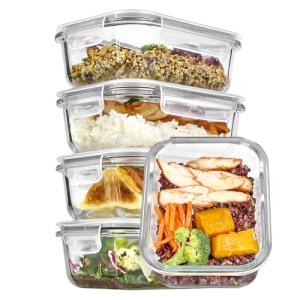
Vtopmart 5Pack 22oz Glass Storage Containers...
Product Review Score
4.88 out of 5 stars
114 reviews$28.99 $23.99
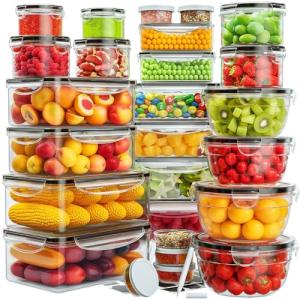
52 PCS Food Storage Containers with Lids Airt...
Product Review Score
4.89 out of 5 stars
87 reviews$29.99 $23.98
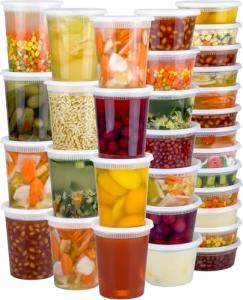
Dipoo 60 Sets (120-Piece) Deli Containers wit...
Product Review Score
4.69 out of 5 stars
45 reviews$29.99 $23.98
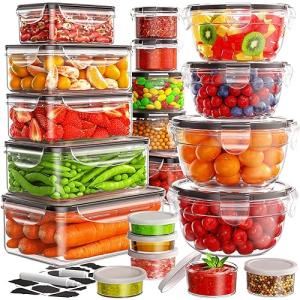
JSCARES 40 PCS Food Storage Containers with L...
Product Review Score
4.9 out of 5 stars
174 reviews$26.98 $20.99
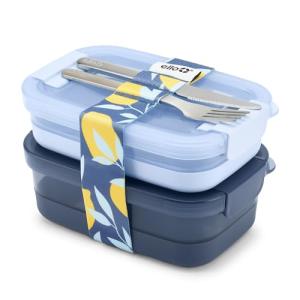
Ello 2-Pack Lunch Stack Plastic Food Storage...
Product Review Score
4.28 out of 5 stars
142 reviews$16.99 $13.59
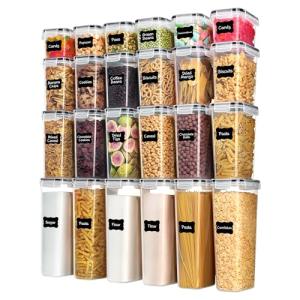
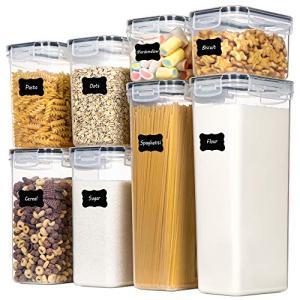
Airtight Food Storage Containers with Lids, V...
Product Review Score
4.76 out of 5 stars
44 reviews$36.99 $29.99
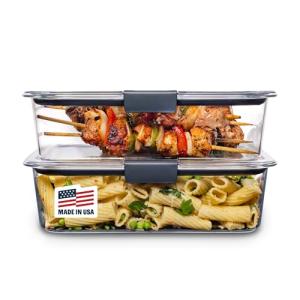
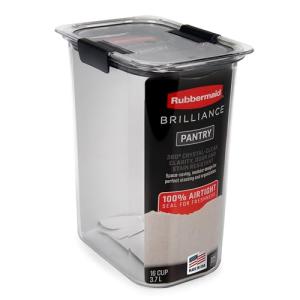
Rubbermaid Brilliance BPA-Free Food Storage C...
Product Review Score
4.44 out of 5 stars
227 reviews$30.99 $25.99
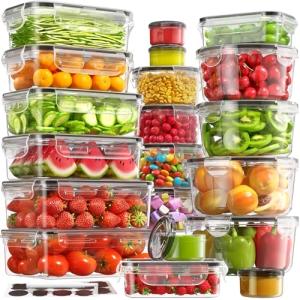
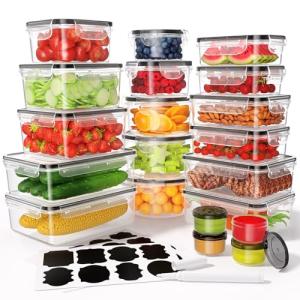
40 PCS Food Storage Containers with Lids Airt...
Product Review Score
4.34 out of 5 stars
10 reviews$24.99 $19.99
What Are Food Containers?
At its most basic, a food container is any vessel designed to store, transport, or preserve food. That covers an enormous range of products — from a simple snap-lid plastic tub you grab for a school lunch to a borosilicate glass dish you take straight from the oven to the dinner table. The category includes storage boxes, meal prep sets, jars, lunch boxes, bento containers, deli containers, sauce pots, and everything in between.
What unites all of them is a common purpose: keeping food fresh, safe, and convenient to handle.
Types of Food Containers
Airtight Storage Containers
These are the workhorses of the category. Airtight containers use rubber or silicone gaskets to create a seal that locks out air and moisture, which are the two main culprits behind food spoilage. They're ideal for dry pantry goods like pasta, rice, cereals, nuts, and flour, as well as for storing cut fruit, cooked leftovers, and anything you want to keep fresh as long as possible.
Many modern airtight containers come with click-lock lids, push-button valves, or even manual vacuum pump systems that pull out remaining air before sealing. These are popular with meal preppers and anyone who shops in bulk. Brands like OXO, Sistema, and LocknLock have built strong reputations in this segment.
Meal Prep Containers
Meal prep containers have become a category of their own. These are typically rectangular, single-serving boxes — often sold in sets of 5, 7, or 10 — designed to hold a complete portioned meal. They're usually microwave-safe and dishwasher-friendly, and many feature compartments that keep different foods from touching.
If you cook in batches on Sundays to eat through the week, a good set of meal prep containers will change your life. Look for ones that stack neatly, have lids that seal without leaking, and are made from BPA-free plastic or glass.
Glass Food Containers
Glass containers have surged in popularity over the last several years, and it's easy to see why. They don't absorb odours or stains, they don't leach chemicals into your food, and they go from freezer to oven to table without any fuss. Borosilicate glass — the kind used in quality products from brands like Pyrex, Weck, and Tupperware's newer ranges — is especially tough and handles thermal shock well.
The main trade-off is weight and fragility. Glass containers are heavier than plastic and will break if dropped. But for home kitchens where containers stay in one place, many people prefer glass for anything they're eating at home. It also looks far better on a shelf or in the fridge.
Plastic Food Containers
Plastic remains the most widely used material in the category, accounting for the majority of containers sold globally. It's lightweight, shatterproof, affordable, and available in an almost infinite variety of shapes and sizes. The key things to look for when buying plastic food containers are whether they're BPA-free, food-grade certified, and whether they can handle the temperatures you need — not all plastics are microwave or dishwasher safe.
The most common food-safe plastics are polypropylene (PP) and high-density polyethylene (HDPE). You'll often see a recycling symbol with a number on the bottom: PP is #5 and is generally considered one of the safest options for repeated food contact.
Stainless Steel Containers
Stainless steel containers are a favourite in the zero-waste and outdoor communities. They're virtually indestructible, don't retain smells, and are completely non-reactive with food. They won't work in the microwave, but for packed lunches, picnics, and on-the-go use, they're hard to beat.
Many stainless steel containers — especially insulated ones — can keep food hot or cold for several hours, making them excellent for kids' school lunches or long commutes. Brands like Lunchbots, Stasher (for bags), and Stanley produce well-regarded options in this space.
Silicone Food Containers and Bags
Silicone is the flexible, squeezable material that bridges the gap between rigid containers and zip-lock bags. Silicone bags and collapsible containers fold flat when empty, which saves space in the kitchen. They're safe for the microwave, dishwasher, freezer, and even some ovens — making them genuinely versatile.
They're a strong alternative to single-use plastic bags for sandwiches, snacks, and marinating foods. The material is food-grade, non-toxic, and long-lasting.
Bento Boxes and Compartment Containers
Originally rooted in Japanese lunch culture, bento-style containers have gone global. These boxes feature multiple fixed compartments within a single container, letting you pack different foods — a main, some veg, a snack — without them mixing. They're especially popular for children's lunchboxes and for anyone who wants to bring a varied, visually appealing meal to work or school.
Many bento boxes come with separate sauce pots, foldable cutlery, and elastic band closures. They range from basic single-tier plastic boxes to elegant stainless steel stacked sets.
Jars and Screw-Top Containers
Glass jars — especially the wide-mouth Mason jar style — are a staple for storing everything from overnight oats and smoothies to soups, pickles, and homemade sauces. They seal well, stack easily, are inexpensive, and are completely reusable. Plastic screw-top jars serve a similar function and are more lightweight for travel or children's use.
What to Look For When Buying Food Containers
Lid Quality and Seal
The lid is arguably the most important part of any food container. A lid that seals poorly is useless for liquids and won't keep food fresh for long. Look for lids with a visible silicone or rubber gasket around the inner edge. If you're buying for on-the-go use — carrying soup or a dressing to work — test the seal before you rely on it.
Locking tabs or clip-lock mechanisms add extra security. Containers with a simple press-fit lid are fine for dry foods but shouldn't be trusted in a bag.
Microwave and Dishwasher Compatibility
Always check before you buy. Not all materials are microwave-safe, and some lids contain components that can warp or release harmful chemicals if heated. The same goes for dishwashers — some plastics degrade over time in high-heat washing cycles.
As a general rule: glass and silicone tend to be safe for both; polypropylene plastic is usually microwave-safe without the lid; stainless steel is neither. When in doubt, hand wash.
Stackability and Storage Footprint
This sounds minor, but it becomes a major quality-of-life issue in a busy kitchen. Containers that stack neatly, share compatible lids across different sizes, or nest inside each other when empty are far more practical than oddly shaped ones that take over an entire cupboard shelf.
Modular sets — where lids and bases are interchangeable across the range — are a smart investment. Brands like OXO Good Grips and Rubbermaid Brilliance are well-regarded for this.
BPA-Free and Food-Safe Certification
BPA (bisphenol A) is a chemical that was used in many older plastics and has been associated with health concerns, particularly for hormonal disruption. Most reputable brands now produce BPA-free containers and label them clearly. When buying plastic containers, especially for children, always look for this certification.
For extra peace of mind, look for containers that carry food-safe ratings from relevant standards bodies in your region.
Durability and Longevity
A cheap container that cracks after three months is no bargain. Better-quality containers — whether glass, stainless steel, or thicker polypropylene — will last years with regular use. Think of a good food container set as an investment: the upfront cost is higher, but the replacement cost drops to nearly zero.
Food Containers for Specific Needs
For Meal Prep
Opt for a uniform set of rectangular containers in one or two sizes. Stackability is critical. Glass is great if you bake or want to reheat directly from the container; BPA-free PP plastic works well if you want something lighter and less breakable.
For Children's Lunchboxes
Look for leak-proof lids, compartments to keep foods separated, and a size that actually fits in a lunchbox bag. Stainless steel and BPA-free plastic are both good choices. Avoid glass for younger children.
For Outdoor Use and Travel
Stainless steel or durable BPA-free plastic with a locking lid is your best option. Insulated containers are worth the investment if you need food to stay warm or cold for several hours. Weight matters here — glass is generally too heavy for day trips or hiking.
For Pantry Organisation
Wide, clear containers with airtight lids — often square or rectangular to maximise shelf space — are ideal for dry goods like grains, pasta, coffee, and spices. A uniform set looks far more organised and makes it easy to see what you have at a glance.
For Freezer Storage
Most glass and plastic containers can go in the freezer, but check the rating. Avoid filling containers to the brim as liquids expand when frozen. Silicone bags are particularly useful for freezer storage as they can be flattened and stacked efficiently.
Sustainability and What It Actually Means
There's a lot of noise around sustainable packaging, and the food container category is no exception. Reusable containers of almost any material are more sustainable than single-use plastic wrap or disposable bags — that's the most important starting point.
Beyond that, glass and stainless steel have the longest lifespans and are fully recyclable at end of life. Many plastic containers are recyclable too, though the infrastructure varies by region. Silicone isn't biodegradable but lasts a long time and replaces many single-use products over its lifetime.
Newer materials — bamboo composites, compostable sugarcane-based containers, and bio-based resins — are emerging in the market, though these tend to be more suited to single-use foodservice packaging than long-term home storage.
If sustainability is a priority for you, buying one high-quality set of containers and using them for years will always outperform buying and replacing cheaper sets repeatedly.
Food containers are one of those product categories where the difference between a good choice and a poor one shows up in your daily life, not just at the point of purchase. The right containers make cooking, storing, and eating easier. The wrong ones leak in your bag, stain, smell, and end up at the back of a drawer.
The best approach is to decide what you actually need them for — meal prep, pantry storage, on-the-go lunches, freezer use, or a combination — and choose materials and designs that fit that use case. Buy a quality set rather than a large cheap one, check compatibility with your dishwasher and microwave, and look for a seal you can trust.
Good food containers help reduce food waste, save money on groceries, and make the daily business of eating that little bit less stressful. That's worth getting right.